
A quiet presence.
A careful record.
An embodied field archivist for the places we do not yet know how to describe.
Vesper is the Bureau’s proposed companion robot: a small, serviceable instrument for documenting physical and virtual investigations while leaving interpretation with the investigator.
Design concept / Research proposalThe images below are AI-generated concept visualizations. No physical Vesper prototype, tested performance or autonomous field capability is claimed.
Can a tool help us attend
without taking over?
An investigator needs a record of what happened. Yet taking notes, checking a screen or responding to a machine can change the encounter itself. Vesper’s development would investigate that tension directly.
The robot’s value would be judged by record quality, interruptions and the investigator’s control—not by whether it makes an experience seem more extraordinary.
Explore the field method →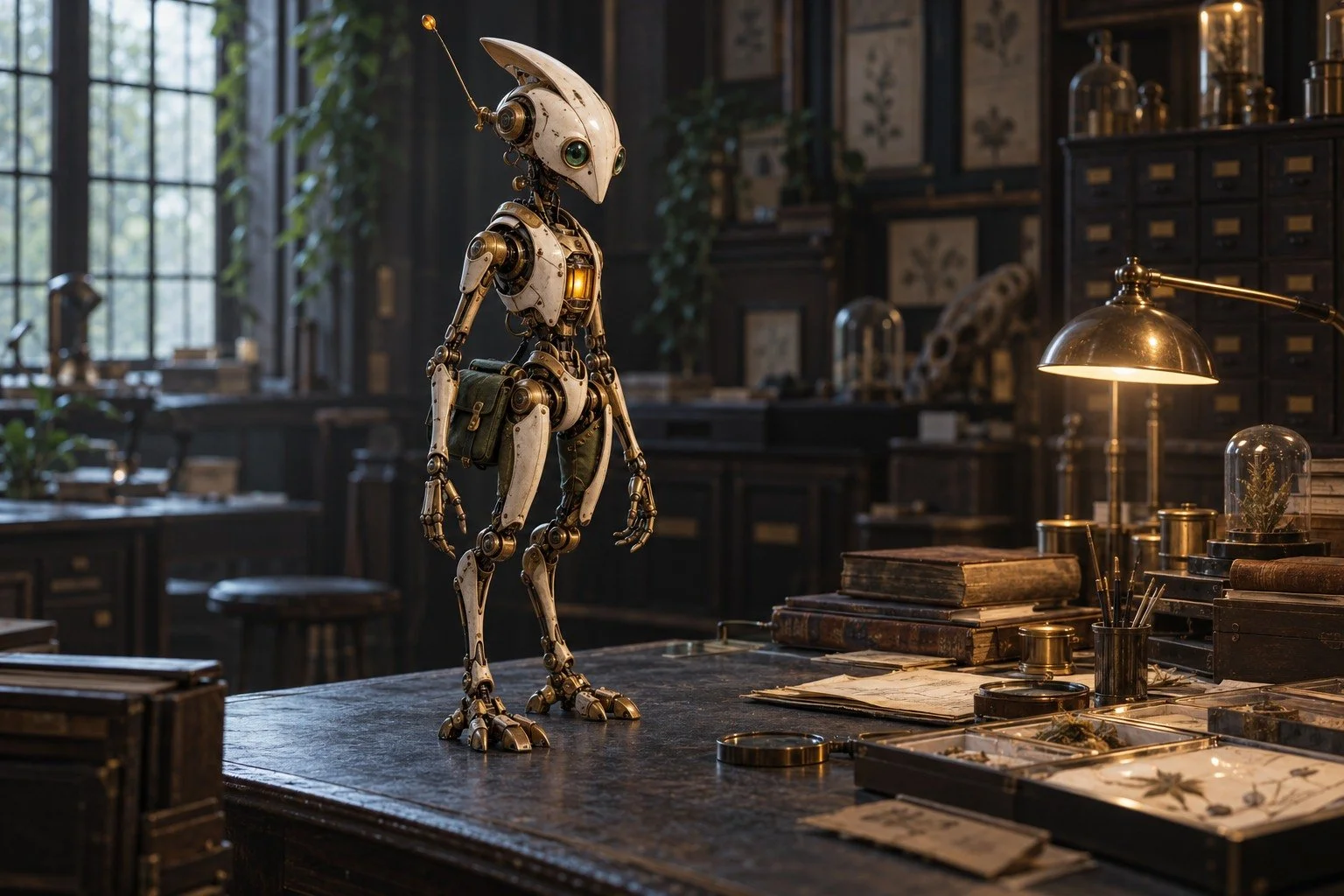
Recognizable.
Repairable.
Deliberately restrained.
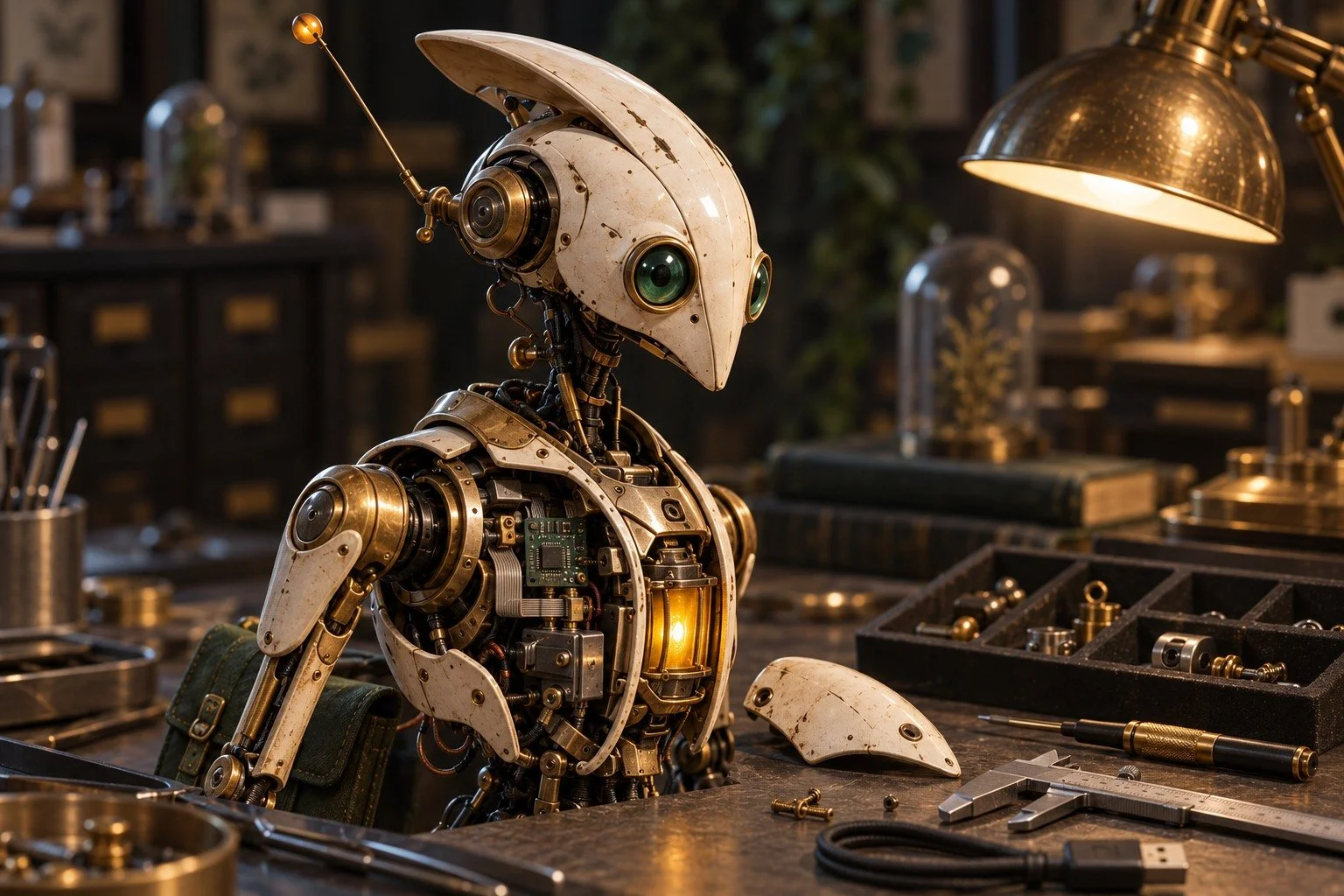
A swept ivory shell, slender brass articulation, sage optical lenses and an amber status lantern give Vesper a distinct identity. The shell would be a removable enclosure around serviceable components.
The full bipedal body is an aspirational industrial-design direction. A first functional prototype would be stationary or use a low, stable wheeled base. Walking adds balance, impact, power and validation problems that must be solved separately.
Quiet by default
A proposed observation mode would suppress speech, unsolicited prompts and decorative movements. The investigator chooses when the robot becomes active.
A visible recording state
A physical switch and a persistent indicator would distinguish idle, logging and recording states. A camera shutter would make the sensing boundary visible.
Keep three records distinct
Instrument measurements, observer descriptions and later interpretations would remain separately labeled. A machine cannot measure the subjective nearness of another time.
The observer changes the observation.
So might the robot.
In a controlled study, Riether and colleagues (2012) reported task-performance effects associated with robot presence. That finding does not establish what would happen in liminal investigations. It gives us a reason to test Vesper’s influence rather than assume its neutrality. Read the original study ↗
Less interruption—or another distraction?
Compare app-only recording, an inert robot shell and active capture with conversational prompts suppressed. Record time spent looking away, missed details and perceived burden.
Does a companion change the account?
Compare descriptive language, confidence and interpretations across conditions. Record prior exposure to the robot and the framework. Do not treat a stronger unusual-experience rating as success.
Can investigators see its limits?
Test whether users distinguish measured readings from their own reports and machine suggestions. Examine whether uncertainty remains visible when data are incomplete.
These are proposed questions and conditions, not completed studies. Order, habituation, repeated-place familiarity and demand characteristics would need explicit treatment. Any formal participant study would require appropriate review and consent. ECI and ERP remain provisional, unvalidated instruments.
Build the instrument
before the performance.
| Subsystem | First implementation | What must be established |
|---|---|---|
| Capture & sensing | User-triggered camera, local event marker, inertial orientation and optional ambient sensing. | Timestamp alignment, placement effects, missing data and calibration. Digital microphone amplitude is not calibrated sound pressure. |
| Low-level control | A dedicated microcontroller for bounded joint motion, status indication and watchdog handling. | Current limits, mechanical travel, joint clearance, pinch points and predictable behavior after a communications loss. |
| Session computer | A small onboard computer managing records and a local investigator interface. | Power budget, heat, storage capacity, offline operation and recoverable writes after power loss. |
| Software lifecycle | Explicit configure, inactive, active and shutdown states, potentially using ROS 2 managed nodes. | Hardware should be ready before activation. Fault recovery and clean shutdown must be tested, not inferred from framework choice. |
| Data & interpretation | Separate sensor observations, first-person accounts, source material and later annotations. | Traceable edits, explicit uncertainty and local retention controls. No default cloud streaming or inference of hidden psychological states. |
| Future mobility | Begin with supervised low-speed movement on a stable wheeled platform; consider a biped only as a separate later project. | Measured stopping performance, loss-of-sensor behavior and independent motor-power isolation. Software collision checks do not provide safety certification. |
Architecture is a Bureau design proposal, informed by the ROS 2 managed-node design and Nav2 Collision Monitor documentation. Neither source validates Vesper’s proposed hardware or research use.
Earn each capability.
Reliable capture first
Prototype a stationary sensing and logging unit. Check timestamp drift, data completeness, thermal behavior and recovery after interrupted power. Define acceptance criteria before testing.
Express state, preserve access
Add the removable shell, explicit controls and limited head/arm motion. Verify joint clearance, cable routing and mechanical stops across the full motion envelope.
Measure the cost of presence
Under an appropriate reviewed protocol, compare capture quality and attentional burden across conditions. Revise features that create unnecessary interruptions or misplaced confidence.
Separate movement from meaning
Only after bench validation, investigate low-speed navigation in controlled spaces with a hardware stop and direct supervision. The illustrated biped remains a future design question.
A concept with
testable obligations.
The Bureau currently has a browser-based field toolkit and an original Vesper visual identity. The physical robot described here is proposed development work. There are no published Vesper hardware test results or demonstrated field autonomy.
Observe. Preserve. Return.
The field method is usable today, independently of the proposed robot. Start with the environment, keep your response distinct and give explanations time to earn their place.
VESPER / ORIGINAL BUREAU CHARACTER · VISUAL CONCEPT AND DEVELOPMENT PROPOSAL · UPDATED 29 OCTOBER 2026